The nights are closing in and with more economic gloom looming, it's easy to find yourself sliding down the slippery slope of demotivation. "What's the point?" "Why bother?" and "Ugh, if I have to..." might be phrases you find yourself uttering from time to time. But when there are so many exciting things to do and achieve in the world, we don't want pesky demotivation to get in the way, do we? Here's the Ginger take on how to keep yourself trim, sharp and motivated.
Part 1: Build a Magnetic Future
Have you ever heard of a walker who accidentally one day stumbled to the top of Everest? Just taking a stroll and "Whoops - what a lovely view"? Me neither. Likewise, if you don't know what your own mountain peak is, the chances are you'll wander round in the foothills without ever reaching the summit. Yet, as soon as you know which mountain you're aiming for, you can start to prepare your ascent.
Building a Magnetic Future means having a strong, detailed and compelling idea of what you want from life. Figure out what your really want and you'll find a deep connection to what keeps you going- otherwise known as your motivation. When something has to happen in your life because you want it so much, it has become a Magnetic Future.

Most of us at some point in life have experienced the pull of a Magnetic Future. You may call it being 'On Purpose,' 'At the top of my game,' or just 'Having a really nice time.' It's the feeling that nothing can get in the way of what has to happen - what's going to happen, because we believe in it so much. So how do you build a Magnetic Future?
1. Start from the end, not the beginning
Forget about what's 'possible' for a moment and think of what you would like to do in your life if you had no constraints. No money issues, no people issues, no place issues, no time issues. What would you like to do in your life? Fill a page of A4 with ideas, words, drawings, images.
2. Find the magnetic force
Take a look at your A4 sheet of paper and see which are the parts of it that really stand out to you. Which are the words or ideas that make you tingle with excitement - and possibly even nerves? If there's nothing on the list that makes you feel that way, go back to your sheet of A4 and think "what could I do in my life that would be outrageous?"
The parts of your paper that stand out to you are the magnet. This will be your driving force to keep you motivated.
3. Turn up the power
Now, ask yourself what would would be different if your magnetic words or ideas became a reality? What would your world look like? How would you behave? What would you achieve? What and who would you interact with? What would you be doing and how would you be doing it?
What would all of this make possible on a broader scale?
What you're doing here is to actually start creating your magnetic future. If you're on the right track, you'll already feel that exciting, motivational pull that shows the magnet is starting to work. Work more on this and you'll hit upon a compelling vision of your future that has to happen. When you really hit that, you'll be unstoppable.
For some people questions like this get their juices flowing instantly, whilst for others they need a different style. That's why I coach people 1-2-1 through processes like this. If you're interested in this technique, but need a helping hand, stop by the Ginger coaching page to find out more about what it involves.
Staying Motivated is not only about building a Magnetic Future - it also has two further steps I call:
Part 2. Getting off those Sticky Floorboards
Part 3. Vanquishing Vampires and Ducking Demons
-----------
This article is a snippet of the Ginger Training & Coaching Staying Motivated programme for organisations. It's already worked well for groups of lawyers and accountants, so it will work for many more groups. Please email biscuits@go-ginger.com or call 0207 3888 645 if you think your organisation would benefit from Staying Motivated.
------------
Further reading:
How Dreams learn to Fly
Give yourself authority to dream.
What's your point? Focus & One-pointedness in action
Here's a nifty little game to put the sparkle back into a close relationship - whether it's a romantic relationship, a friendship or a tight-knit professional relationship- The Appreciation Game.
What's it good for?
This game is perfect for any relationship where you're a bit tired with the dynamic. Perhaps arguments continually creep in, or perhaps you just feel flat, bored or dulled by what you do together. The Appreciation Game is a great way of zapping confidence, liveliness, humour and a renewed sense of friendship into the relationship, as well as... well, having a greater sense of appreciation for that person.
It's great fun, it works and you'll learn something about yourself along the way!
 How to do it
Put aside your regular tasks, mundane goings on and usual way of thinking about this person and find yourself a place where both of you feel relaxed. If you're at home, go out - if you're at work, find a nice cafe or park to go to somewhere nearby. Sit down, look each other in the eye and begin.
The Appreciation Game is exactly what you might expect - each person appreciating the other. Start by one person giving the other just one thing that they appreciate them for. If it's difficult, start with something non-personal, like "I appreciate you for always wearing nice shoes" (don't worry, the appreciations will get better).
Then the other person responds with an appreciation and so you go on. Your appreciation can be absolutely anything- small or large; past, present or future. There are three rules:
1) It must be an authentic appreciation (Never an underhand way of criticising the other person. Not that you would...)
2) No volleying: you're not allowed to tell the other person "Awww... you too" to their appreciation. That would be lazy. Think up your own appreciation.
3) The only response to the appreciation you're allowed is "Thank you." No "Yes, but I didn't..." or "You're only saying that because..." Swallow your appreciation without wriggling around it.
That's it - simple!
Enjoy, and let me know how it goes...
Further reading:
Happiness Exercise 1: The "I like" page
Happiness Exercise 2: The "Not-to-do List"
Happiness Exercise 4: The Wheel of Delight
Whether you're talking about you make pencils or jet them off to illiterate kids in Eritrea, there are some typical things you may say in a presentation to get people to support your work. The more these messages stick in people's minds, the more success you'll have in what you do.
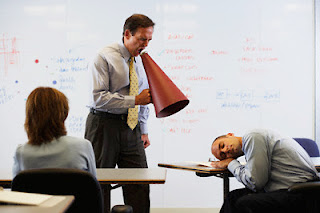
The trouble is, that even those who don't technically fear public speaking, do fear saying something unprofessional. And it's understandable. If speaking in public isn't an environment you swim about in day-to-day, your nerves will be heightened by the task. You already feel pretty silly standing up to talk, your brain then chips in with a resounding 'No!' and there's that voice inside your head dying to tell you how much people are judging you. 'Don't do anything different and for god's sake, be professional.'
This desire to be professional leads to us giving exactly the same presentation as everyone else (you know the one: a powerpoint with four neat bullets down the side and a picture in the right hand corner). If professional is to fit right in with what everyone else is saying - job done. If professional is to be bland, then another job done.
But wait a minute. How many of those 'professional' presentations have you sat through? You probably don't have enough fingers. And how many of them can you remember in any detail? Do you even need any fingers to count those? Speakers who focus on being professional and mild, are in fact doing everyone in the room a disservice. Far from being pleasant and inoffensive to listen to, they are subjecting their audience to a presentation which they won't remember and their organisation is losing ground to organisations where the presenters make their message stick.
So what does it take to make your message stick?
There are three broad areas to consider to make your message stand out. Take a look at each of these below and see which you use and how you could use them differently to engage your audience.
1) Visual aids
How you use your powerpoint, flipchart, props, or physical space to engage, or disengage your audience. Do you ever do a presentation without powerpoint? What if you pre-prepared a flipchart or powerpoint with no words- only pictures and numbers?
2) 'Verbal aids'
The nuggets of gold that come out of your mouth. These could be metaphors, poems, a personal story, a famous example, a joke, quotes, powerful facts, collections of three or buzz phrases to repeat. These all add variety, depth and emotional buy-in to a presentation. They also provide a good opportunity for you to stimulate both the left, logical part of the brain and the right through powerful evidence, emotional part of the brain through rapport-building stories.
3) Interactivity
My personal favourite is to get audiences involved in information as people far & wide learn best by doing. This could be something so simple as a brainstorm, or elaborate like a challenge, quiz, team game, or role play. With any interactivity, make sure that your full energy goes behind the task, so as to motivate others to get involved.
But before you run off and play, remember the "RULE" of memorability. To be successful, any visual, verbal or interactive 'nugget' that you slot into your presentation should be:
R - Relevant
Somewhere along the line, we were told to "start with a joke." This is like saying "Start with something to distract the audience, then you can get into the really boring bit." Any tool that you use should link clearly to your message, rather than pulling away from it.
U - Unusual
The unusual or unexpected often has the effect of tricking the brain out of its stereotypes and leads to the creation of new neural pathways. This means more learning which is retained for a longer period of time.
L - Learning
The best nuggets usually take the audience forwards and teach them something new. Give your audience insight and they'll see you as an expert in your field. Repeating or reiterating key learning points reinforces them.
E - Exciting
It's not to say that you have to have your audience leaping out of their seats with thrills, but a good nugget excites, or stimulates a part of the audience's mind - whether it's their imagination, their motivation, or their logical mind. You're looking to create "ooh" and "ahah!" moments with what you say, show and do.
Stick to these rules and your presentations will start to stick. Next time you do a presentation, pick a new nugget and give it the "RULE" treatment. Give yourself permission to experiment.
For more information on how to progress with your public speaking through a coaching programme please take a peek at Ginger Training & Coaching's public speaking programme.
Related articles:
Public Speaking with Wings e-book
Grim Gestures - the top 10 gestures mistakes
Awareness- the first tool to outstanding public speaking
I was pondering my ability to focus this Easter weekend (before I got distracted by a chocolate egg) and reminded myself of what Buddhists call 'one-pointedness'- a state of complete concentration where you are completely on-task, or in-the-moment. Given my own flighty nature when faced with a day of activity in the office, I set about investigating one-pointedness to see how I can find and keep to my own single-point more often.
I asked myself the following questions, which I invite you to ask yourself too...
What does it mean to be many-pointed?
I've always considered myself a great multitasker, so why should I change my ways? First stop, a consideration of my current situation - what effect does being many-pointed have on me? We've all had those days where we set off to get something done, but without much focus. At work, it's that day where there's so much to do you don't know where to start. If you're anything like me, your first step (and third and sixth step) is to check your email. You're heading somewhere, but you don't know where and suddenly 'urgent' emails, phone calls or questions from colleagues are all you can seem to get through. Perhaps it's no surprise that days like that tend to finish in frustration, exhaustion or a feeling of 'peh... what was that?' This is a many-pointed day.
Although I think I love multi-tasking, when I consider how many-pointedness really makes me feel, it's words like stressful, breathless, darting, anxious, pulling, pushing, changing and regretting that spring to mind. It brings the discomforting feeling that I'm not really living up to my best, which only brings more confusion and panic.
How does One-pointedness feel?
Should I take that moment of confusion and panic and myself into a one-pointed mindset, how does that feel? For me words like this come up: space, focus, calm, purpose, simplicity, sensing, timeless, easy, tireless, light, connected, right, effortless, relaxed... and so on. There's a beautiful simplicity and balance that we instinctively know comes with us finding focus.
What does One-pointedness think like?
Let's go deeper into the mind-set of one-pointed focus. If you were Mrs One-Pointed herself, what sort of language would run through your head? For me, it's the following;
- This is the only important thing there is right now
- My task is the right one beyond doubt
- I have everything I need to make this happen
- This will happen with a little patience and calm
How do I get One-pointed?
Buddhism has skillful and long-term methods for training the mind to become focused on a single point. Whilst not attempting to better those fine teachings, I devised a three step process for upping one-pointedness in every day life;
1) CHOOSE
Your first step in becoming one-pointed is in picking one thing to do at a time. It's like picking one cake to eat at a time, rather than shoving in the chocolate eclair with the apple tart, with a chicken sandwich. It seems obvious, but we so often fail to take this crucial step. The important thing here is that you make a conscious choice- rather than getting blown this way or that by emails, twitter, text messages and so on. (Later this month we'll look at what to do if you have to react to your situation rather than choose.)
To get here you may have to spend time considering, planning, researching and analysing without the 'assistance' of your inbox. To stay here, you must also make the firm choice to honour your choice, even if other more attractive offers (read: a better cake) come along whilst you're still chewing.
2) DO
Many people love the planning bit, but then fail on action. I'm a classic example when it comes to selling my products. I spend hours designing a wonderful product, I think through who I'll market it to, how I'll market it and then... get distracted by a new opportunity before I follow it through. An effective "DO" stage is where the one-pointedness happens. It's all about noticing any distracting thoughts, acknowledging them rather than repressing or ignoring them and then letting them pass without influencing you. Expect to be pulled off-task - it will happen. But with every sense and thought, patiently and continually refocus yourself back to what you chose to do.
You'll find techniques to strengthen your DO stage on the way and we'll investigate some of these later in the month.
3) FINISH
Everyone has a limit to their attention span (for adults we focus at our maximum for around 20 minutes), so having an end to your task will ensure that you can set yourself up to succeed. The finish is the bit where you can say to yourself "That's it, completed, finished, end of story" before starting on something else. It's important to congratulate yourself when you get here, no matter how small your victory, as it motivates your subconscious mind to focus again next time you take on a choice. After finishing and congratulating yourself, only now do you critique the process you went through to get there to improve it for next time. This is critical so that that self-doubt doesn't derail your choice during the DO stage.
This month is One-Pointed April, so follow this blog for more in the coming weeks. Please contribute with your questions and comments below.
 Happiness lessons from the world of social entreprise.
Having spent the best part of a year working in the Hub Islington; a fabulous work space for micro social enterprises & other do-gooders, I came to notice a strange phenomenon. By most professional standards the wages these guys bring in are small indeed, yet somehow their job - and life - satisfaction is much higher than your typical work environment.
Take the number of voiced complaints per minute as a good anecdotal indicator of how happy a workplace is. Be it a "damn, stupid computer," a subtle 'tut' at a colleague as they walk away, or a colleagiate grumble about how slow the morning's going; complaints form the background mumble of most offices.
Yet at the Hub, the atmosphere is different. It's 4 degrees outside (and therefore the same inside), the recycled wood chip heater's just packed in and now it's started raining onto someone's computer. Yet, still there's no sign of cynicism or complaint, just an "oops!" and the sound of a social entrepreneur scuttling to get a bowl to catch the drip.
According to our chosen economic model, there's something seriously wrong here. Money = happiness, right? Or if that doesn't convince you, then surely money = stuff = happiness will tempt you? (Don't you want that new Ikea sofa?) According to Coca-Cola, MacDonalds and, let's face it, even producers of fair trade products, shouldn't it be those with lower wages who are grumpy and those who can afford more 'stuff' who are cheerful and happy? Under this model, how can it be that those with less money and less 'stuff' appear happier?
"Alright, they might be happy-but-empoverished idealists for now," a typical career sort might argue, "but look a few years down the line when our high earners have paid off their mortgages, got their new car and have luxury holidays every year, and then you'll see who's happy." Still the idealists, I'm afraid to say, if research emerging over the past 10 years is to be believed. We know from various studies that people that people who are more materially orientated have lower levels of life satisfaction (see, for example, this study on business students, materialism & wellbeing). We also know that once your personal wealth (the value of your personal assets) has reached of $12k, an increase in wealth no longer affects your happiness.
So if it's not money, what is making our social entrepreneurs so happy with life? Here are my ideas;
1) The choice to forget about consumption
There are a lot of eco-aware sorts in the social enterprise scene, who have made the choice that they want to consume less for the sake of the environment. This doesn't just mean buying organic, but also buying second-hand clothing, or even swapping it. By not playing the consumption game, they're not stuck in the use-more, want-more, work-more, buy-more cycle (see http://www.storyofstuff.com for a wonderful, lighthearted video on this)
2) The choice of a higher purpose
It comes down to simple maths. I = 1. You = lots more than 1. If you focus your efforts at work on a higher purpose you see that there are many people who suffer more than yourself, many people who need help. In devoting yourself to a cause you'll naturally fail to see the minor agitations you face on the way - they're just not worth complaining about.
3) The choice of community
The Hub provides London a haven of much needed community. People sit & work together, collaborate on projects, often for free and even (cover your eyes if you're a Pret lunch fan) cook and eat together. We know instinctively that we're happiest when we're in a social environment, yet due to Hofstede's famous cross-cultural studies we have known for decades that as GDP rises, we become more focused on ourselves. At The Hub people chose togetherness rather than isolation.The crucial point here is that these individuals chose their consumption patterns, their purpose and their community. These are choices we all make, every day.
Is it as simple as a choice between wealth and happiness? I'd love to hear your thoughts...


