It's difficult to go even a few hours without judging others, for better or for worse. In fact, we often see it as a useful way of ordering people when we meet them. In its crudest form, judging is a tool to show us who to push away and who to pull closer. But what does your reaction to them say about you? Read on to share a revelation that changed my life.
On today's pre-work stroll around the block, I passed a tall vicar walking on his own in the sunshine. He struck me as purposeful and assertive. My snap reaction was  subtle, but distinct. "Look at him in his black robes," I snarled to myself. And then, in a connection that was completely apparent to me in that moment (for, what else would black robes mean?)- "Who does he think he is? He must be completely proud." I walked passed, being careful not to make eye contact and feeling smug that I don't suffer from pride like him.
My second reaction was more like "ahah!" because I realised I had fallen into a trap. It reminded me to apply an important concept I share with a lot of my clients:
What we see in others says nothing about them and everything about us.
When we judge others, we're not judging them, not really. How could we, when we often have no information about them? In the instance of my vicar - a complete stranger- I was reacting to something that I assumed about him that resonated with something inside me. It wasn't his pride I was picking up on, it was my own.
Check it out for yourself - why else could it be that some people really annoy you, when others around find the same person perfectly good company? No matter how much of a pain an individual may be, there's always someone who can see good in them.
Be careful, this could change your life. Because now, when you get frustrated at someone for being a control freak, you can instead investigate the way in which you're being a control freak at that moment. If you see someone as hogging a conversation, could it grate on you because there's a side of you who wants to be the one talking?
It's time to ask yourself a tough question: What does your idea of 'them' say about you? So you've always felt that your parents don't listen to you- when did you last give them a really good listening to? Is that senior person in your organisation intimidating you, or is it your insecurity that you need to deal with? Should the person with the loud laugh on the bus really shut up, or do you have something to understand and let out?
Putting it into action
1. Think of someone, or a group of people who you find frustrating. Write a list of all of the judgements you make about them. Don't hold back.
2. Take a good look at that list and circle all the ones you could possibly take responsibility for.
3. Absorb responsibility for these judgements. Notice the shift in your behaviour that happens if you then see them as your qualities, or your discomforts, rather than blaming the other person. Interesting?
4. Now take a look at any of the list that weren't circled. These are the judgements that probably cause you the reaction "No way. That's definitely her, not me." Fair enough, that might be part of the truth. And I also know from experience that the strongest adverse reaction in this exercise is often the one that is closest to your real behaviour. For the sake of argument, take this judgement upon yourself and accept, just for a few moments, that it's true. What is true about it? If you wrote "What frustrates me is that she's too old" and you're in your early twenties and feeling, it's clear that it's not being too old that's your problem. But perhaps you have a problem with the idea of getting old, or perhaps you're secretly uncomfortable about being too young. Investigate it.
5. Keep aware of your judgements and next time you judge a passing vicar, use it as a chance to learn something about yourself.
Sarah Lloyd-Hughes is a Life Coach whose techniques are influenced by Tibetan Buddhism. She specialises in helping people on their journey towards sustainable happiness. See here for more detail.
Further articles
Find out more about how coaching answers the tough questions
Happiness Exercise 1 : The "I Like" Page
A word from your saboteur
How dreams learn to fly
Welcome to the first in a series of bite sized exercises to help you boost your ability to create positive change in your life.
I'd like to share with you one of my favourite techniques for making mental habits more positive - the "I Like" page. Simply take a sheet of paper, write "I Like" in the middle of it and fill the page with all the good things you notice over the course of the day - from the mundane to the majestic.
 How to do it
The technique is as simple as it sounds, but it may take a little practice to get moving, especially when you're staring at a blank page. The trick is to include anything you like, starting from the things you can physically see around you. If you're still struggling, take a walk and look around you at nature, or think of the little moments in life that give you pleasure.
What's it good for?
Whenever I need a boost in positivity, I whip out an "I Like" page. Just focusing on positive things around you increases your capacity to do get things done, because the mind works more incisively when its energy isn't spread across different worries and concerns. From a positive mindset, obstacles generally seem less significant and therefore easier to overcome - test this to see if it's right for you.
Secondly, an "I Like" page can distract from a big, sticky problem that won't seem to go away. Simply removing yourself from that 'stuck' perspective for a few minutes is often enough to find a different, more positive way to progress. How can you worry when your mind is on crusty bread, or barefoot on grass?
Thirdly, the technique works on your creativity and even humour, by encouraging you to recognise every little thing that makes you feel positive. For example, as I was writing this page I heard a child's laughter on a nearby table. Looking up, I realised it was an old lady with a big grin - wonderful!
Fourthly, using this technique over time builds mental resilience and contributes to general happiness. In conditioning yourself to notice the good in every situation, rather than the bad, you will start to find yourself thinking and acting more positively. Would you rather be surrounded by a world of average, dull things, people and ideas, or one that is creative, alive and exciting?
I do love a good "I like" page - so much that the technique in itself will probably make it onto my next "I Like" page. I'd love to see how it works for you- please give it a shot and post a comment.
Happiness Exercise 4: The Wheel of Delight
Happiness Exercise 3: The Appreciation Game
Happiness Exercise 2: The Not-to-do List
Ever felt like whatever you do, you can't quite seem to motivate yourself? If so, the chances are you're hosting a saboteur - a negative pattern of thought that leads to negative patterns of behaviour. Let's investigate...
Meet Jeremy...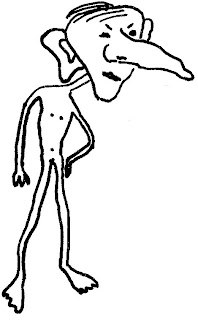
Jeremy, pictured right, is the personification of my very own saboteur. He has pale, blueish skin and a thin voice in my head that whines at me that I'm not good enough, strong enough, clever enough, experienced enough. Whenever I feel intimidated, low in energy, or if business is going badly, Jeremy is right there to tell me 'Told you so.' And I feel his effect on a physical level. My shoulders slump, I find problems everywhere I turn and I seek refuge in a coping mechanism like cake. Saboteurs are many and varied, but always have the effect of lowering your energy and moving you away from your goals. They can take two forms;
1. The saboteur who holds you back
Consider the attractive looking person the other side of the bar. You're feeling pretty positive and are about to make a move. Then. Out comes the saboteur to remind you... you're not wearing the right clothes, you don't know what to say, s/he might think you're strange/ too forward/ not intelligent enough. Instead, you turn back and hunch your shoulders around your drink You hate the saboteur for it, you wish you were stronger, but the result is there. Too much thinking and your saboteur has talked you out of it.
2. The saboteur who makes you lazy
Even more tricky is the saboteur who keeps you 'stuck' and you don't even notice. This is a voice that's subtle and deep rooted. It encourages you not to bother, or not to look for new solutions - 'It's easier to stay how you are' or 'stick to what you're good at.' It tells you that you're too old / busy / experienced to change and that you couldn't even begin to learn to paint / dance / speak in public. This is the voice that thinks it knows what we're capable of. And it's the voice that keeps us firmly kept in our comfort zone, doing the same things as we've always done.
How to tackle your saboteur?
1. The first step is to become aware that a saboteur is present. In your daily activity, start to notice the energy levels in your body and the language that's knocking around in your head. Watch out for slumped body language and a feeling of being squashed, restricted or pushed down. Listen out for thoughts or words like "I should..." or "I have to..." or "I'm supposed to..." coming out of you, which are all signs that you're acting out of obligation, rather than choice. This is the environment a saboteur likes to create for themselves, as they feed from insecurities.
2. Once you think you've found a saboteur, it's time to investigate it. Shine a strong light on many saboteurs and you realise they were just like a little dog with a big bark. By inviting the negative part of your mindset a chance to air its frustrations and concerns, you can get some distance to those thoughts, rather than risk being controlled by them in a moment when you can do little else. As those thoughts come out, we often see how unreasonable and unnecessary they are.
3. Now that you're starting to know more about your saboteur, you can study the triggers for them showing up. What leads you into this pattern of thought and what can you do next time to stop it from happening?
4. Understanding and visualising an image of your saboteur can help you to undermine it. By having a (frankly ridiculous) image of my own saboteur, I'm able to treat him light-heartedly - like a difficult relative - and say "Oh, that's just Jeremy's way, don't worry about him, he'll be finished soon."
5. Soon you'll learn that you choose which thought processes you put energy into. Do you want to spend time indulging the negative pattern of a saboteur, or would you prefer to let those thoughts pass in favour of something more encouraging and energising?
Related articles
Give yourself authority to dream!
What's your point? - Focus & one-pointedness
Whether you're talking about you make pencils or jet them off to illiterate kids in Eritrea, there are some typical things you may say in a presentation to get people to support your work. The more these messages stick in people's minds, the more success you'll have in what you do.

The trouble is, that even those who don't technically fear public speaking, do fear saying something unprofessional. And it's understandable. If speaking in public isn't an environment you swim about in day-to-day, your nerves will be heightened by the task. You already feel pretty silly standing up to talk, your brain then chips in with a resounding 'No!' and there's that voice inside your head dying to tell you how much people are judging you. 'Don't do anything different and for god's sake, be professional.'
This desire to be professional leads to us giving exactly the same presentation as everyone else (you know the one: a powerpoint with four neat bullets down the side and a picture in the right hand corner). If professional is to fit right in with what everyone else is saying - job done. If professional is to be bland, then another job done.
But wait a minute. How many of those 'professional' presentations have you sat through? You probably don't have enough fingers. And how many of them can you remember in any detail? Do you even need any fingers to count those? Speakers who focus on being professional and mild, are in fact doing everyone in the room a disservice. Far from being pleasant and inoffensive to listen to, they are subjecting their audience to a presentation which they won't remember and their organisation is losing ground to organisations where the presenters make their message stick.
So what does it take to make your message stick?
There are three broad areas to consider to make your message stand out. Take a look at each of these below and see which you use and how you could use them differently to engage your audience.
1) Visual aids
How you use your powerpoint, flipchart, props, or physical space to engage, or disengage your audience. Do you ever do a presentation without powerpoint? What if you pre-prepared a flipchart or powerpoint with no words- only pictures and numbers?
2) 'Verbal aids'
The nuggets of gold that come out of your mouth. These could be metaphors, poems, a personal story, a famous example, a joke, quotes, powerful facts, collections of three or buzz phrases to repeat. These all add variety, depth and emotional buy-in to a presentation. They also provide a good opportunity for you to stimulate both the left, logical part of the brain and the right through powerful evidence, emotional part of the brain through rapport-building stories.
3) Interactivity
My personal favourite is to get audiences involved in information as people far & wide learn best by doing. This could be something so simple as a brainstorm, or elaborate like a challenge, quiz, team game, or role play. With any interactivity, make sure that your full energy goes behind the task, so as to motivate others to get involved.
But before you run off and play, remember the "RULE" of memorability. To be successful, any visual, verbal or interactive 'nugget' that you slot into your presentation should be:
R - Relevant
Somewhere along the line, we were told to "start with a joke." This is like saying "Start with something to distract the audience, then you can get into the really boring bit." Any tool that you use should link clearly to your message, rather than pulling away from it.
U - Unusual
The unusual or unexpected often has the effect of tricking the brain out of its stereotypes and leads to the creation of new neural pathways. This means more learning which is retained for a longer period of time.
L - Learning
The best nuggets usually take the audience forwards and teach them something new. Give your audience insight and they'll see you as an expert in your field. Repeating or reiterating key learning points reinforces them.
E - Exciting
It's not to say that you have to have your audience leaping out of their seats with thrills, but a good nugget excites, or stimulates a part of the audience's mind - whether it's their imagination, their motivation, or their logical mind. You're looking to create "ooh" and "ahah!" moments with what you say, show and do.
Stick to these rules and your presentations will start to stick. Next time you do a presentation, pick a new nugget and give it the "RULE" treatment. Give yourself permission to experiment.
For more information on how to progress with your public speaking through a coaching programme please take a peek at Ginger Training & Coaching's public speaking programme.
Related articles:
Public Speaking with Wings e-book
Grim Gestures - the top 10 gestures mistakes
Awareness- the first tool to outstanding public speaking
 I wrote recently about my friends Mark & Denise who entered a competition to live their dream lifestyle for six months. Did they win the Ultimate Job competition? Have a look here to see their journey and my thoughts.
Mark & Denise's efforts inspired me to think more about how dreams become reality, particularly because this is something I help my coaching clients with every day. So, just what does it take to make your dream fly?
1) Before you reach a peak, you need a mountain to climb
If we don't know where we're trying to get to, how can we complain when we don't get there? One of the biggest challenges is to work out what you really want from your life. I started to ponder dreaming based on Mark & Denise's example in this article: Give yourself the Authority to Dream. What I learned was how much we restrict ourselves to the habits of our current reality; a path we chose perhaps many years ago and perhaps without conscious choice.
If Psychologists are right in saying that 90-95% of our thoughts today are the same as our thoughts yesterday, what impact does that have on our capacity to dream up changes in our lives? Ask yourself this;
- When did I last do something that felt thrilling?
- What was the last thing I wished for?
- When I wish for things, how often are they in my usual range of habits and how often are they big, or even scary wishes?
There are plenty of techniques to help you dream outside of your habitual patterns, or comfort zone. One of my favourites that I do with my clients is to help them visualise a fantastic future, based not on their logic, but based on their deep internal desires. That, incidentally, is where Ginger came from. You can use vision boards, positive affirmation, work on personal meaning and even a shopping spree to help you strengthen your dream. By creating a rock solid dream- a future that's so utterly desirable - anything else that gets in the way will seem insignificant.
2. Build your confidence muscle
We're afraid to dream because of the risks. What if I fail? and What if I lose what I already have? are two big ones, but I believe they hide an even bigger fear - What if I get what I want?
Whatever the fear, we can train ourselves gradually to have confidence in our ability to succeed and our ability to cope with success. That confidence, of course, becomes a self-fulfilling prophecy. But, like any muscle, your confidence muscle needs training. Of course you may not have the confidence (or opportunity) to run for Prime Minister right now, but if you set yourself tiny goals to achieve, then celebrate and reaffirm your success, you'll find that over time your self confidence grows and your ability to dream strengthens. And with your strengthening confidence muscle, bigger and more powerful dreams are possible. Not to mention the connections and possibilities you naturally come across that help you on your way over time.
Start really small and focus on your power to make something happen in your life. If you're building trust in yourself, fulfil even the tiniest of promises you make to yourself. Get up when you say you'll get up; call home when you agreed and follow up on that person asking for your help. Achieve all the goals you set for yourself in a month and you'll see the difference in your confidence.
3. Give yourself time & space
Ever given up on an idea half way through, thinking they're not working, only to find a few weeks later that if you'd kept going you would've succeeded?
Remember to build your confidence and your dream over time, without being put off. If you climb a few metres up one mountain, then decide to change to a different mountain because it looks easier, you may never reach a summit. Recogise that it often months and years to reach dreams. Here it's important you have that rock solid dream, so that you can cling on even when times get tough. And you can prepare yourself for those tough times by acknowledging the following:
- Your mind will play tricks on your to try to put you off (we call it the saboteur, the inner critic, the gremlin...)
- You will get there if you keep going
- What happens in your life is nobody's choice but yours
And finally, don't forget that it is you who makes your dreams happen, by making your dreams happen.
Related articles
Give yourself the authority to dream!
What's your point? Focus & one-pointedness in action
 Two friends of mine recently entered a competition to with the Ultimate Job in Ireland (and Probably the world) and have just been shortlisted in the top 10 out of hundreds of applications. They're now in with a chance of spending 6 months travelling the world to test out honeymoon venues.
You can see the moment when they found out they got shortlilsted here. What struck me was their willingness to dream this into reality and the effect it had on the outcome. Here's the difference between them and me:
Me - I looked at the website and thought "pfff... I can't make a video and even if I could and did, there's no way I'd win"
Mark & Denise - with vision boards, bundles of dreaming out-loud and a go-getting attitude (including doing a 2k run dressed as bride & groom), they'd already experienced getting into the Top 10. It's like the famous instance when Edmund Hilary, having climbed Everest was asked how it felt. He responded that it was just like every other time he'd climbed it in his dreams.
Giving ourselves the authority to dream actually allows those dreams to become a reality. Mark & Denise (along with Buddhism and The Law of Attraction) showed me that we can literally conjure anything we want into our lives. In fact more than that- that our lives are actually a physical representation of what we dream for.
It's because with a dream we're much more focused on creating an outcome. With a mountain like Everest to climb, you're not going to see the Hillaries of the world lurking around the bottom for too long.
But there's a couple of limiting beliefs that get in the way - otherwise we'd all be living our dreams. Here's a few I've identified:
- To put ourselves out there and say "I want that" publically is to risk failure if we don't get it
- The belief that somehow they would be able to do it because they're that sort of person. Whereas we could never manage it.
- Focusing on other 'serious' parts of life that we've constructed for ourselves in favour of the things we really want to do.
Why, I ask?
I dreamt of running my own training business, and here I am. Now, Mark and Denise have inspired me to ask... What else can I conjure?
Good luck for the finals guys!
Update 10th May 2010:
Of course it hardly came as a surprise, but it was an incredible pleasure to hear that yesterday Mark & Denise actually won the Ultimate Job! Congratulations to them both for their hard work and self-belief that made this possible.
Related articles
What's your point? Focus & one-pointedness in action

As he finishes to his last point, Edgar Mumble looks up at the audience. ‘Phew, it’s over,’ he thinks with satisfaction. He half-heartedly asks if anyone has any questions and then, when his offer is met with silence, he scuttles out of the room to a thin ripple of applause.
‘That was pretty alright,’ he tells himself with a relieved sigh, ‘I’ll do the same presentation again next year.’
How many times have you sat through a similar scenario? How many times have you been the speaker with the same attitude? The good news is that it doesn't have to be that way- and the first step in this (and any other) personal development process is to become aware of yourself and your impact on the world. There's no other way to get the distance needed to change your actions?
Awareness starts with a desire to do better, so first you need to want to give a presentation that doesn't just pass for 'okayish.' Just in case you're on the fence, look at those people who you know who entertain and dazzle their audiences. Do you prefer hearing them talk? Do you listen more and remember more about what they say? Chances are you do.
So, have you got the motivation? Good. Now you’ll do well with a framework for analysing yourself. Buddhists, the masters of awareness, identify five different centres in the body. Four of these are relevant for public speaking awareness- our body, speech, mind and qualities. Let's take a look at each in turn:
Body
First, consider your eye contact – do you cover all of the room or do you hold onto a supportive-looking group on the left hand side? Do you have the tenacity to make eye contact with specific people for 1-3 seconds, or do you find yourself inspecting the ceiling because that way you can pretend you have nobody watching you?
Second, look at your gestures. Take your hands away from your ear, the back of your head, your necklace and other undesirable places (we all do it). And stop with the flappy, general and repetitive hand movements. Now you’ve got some space for crafting gestures that tell your story and emphasize the bits you want your audience to remember. Pick gestures that are strong and memorable.
And there’s much more. Consider the way you hold your body, your facial expressions and how you move. You will, of course, be ditching the lectern.
Speech
Look at the way your voice behaves when you talk in public. Once your volume’s not too loud and not too soft, but just right, you can start to use it as a tool for adding drama and tension into what you say. Same goes for an awareness of your gaps, your intonation, your clarity, your energy and so on. Play with your voice and use it to create a story that engages your audience.
Mind
The voices in our mind can play funny tricks on us if we’re unaware on stage. Because we take our nerves seriously we feel that fight-or-flight are the only two serious choices. If we’re aware, we’ll learn that our nerves are energy that can either help, or hinder our performance. That energy can either be labelled 'fear' or 'excitement.' We chose which way it goes.
Qualities
And finally, awareness of your qualities will indicate the kind of presenter you can be at your very finest. Your ‘stage persona’ – be it the Kind Expert, the Competitive Dad the Energiser Bunny, or countless others, will provide you with hooks for creating humour and themes that are natural and dazzling.
To develop your stage persona, start by pondering the ideal persona for your message. Are you challenging, or consensus focused; serious or humorous? Now, look at where you are on each of those spectrums. The gap is your list of points to develop.
If you'd like to learn more about these techniques, join the next Public Speaking with Wings- Your Presenter's Toolkit session - http://www.go-ginger.com/workshops.html. You can also request a free Public Speaking with Wings e-book here which goes into further techniques for becoming a master of public speaking.
Related articles:
Grim Gestures - the top 10 gestures mistakes

 subtle, but distinct. "Look at him in his black robes," I snarled to myself. And then, in a connection that was completely apparent to me in that moment (for, what else would black robes mean?)- "Who does he think he is? He must be completely proud." I walked passed, being careful not to make eye contact and feeling smug that I don't suffer from pride like him.


